
Introduction
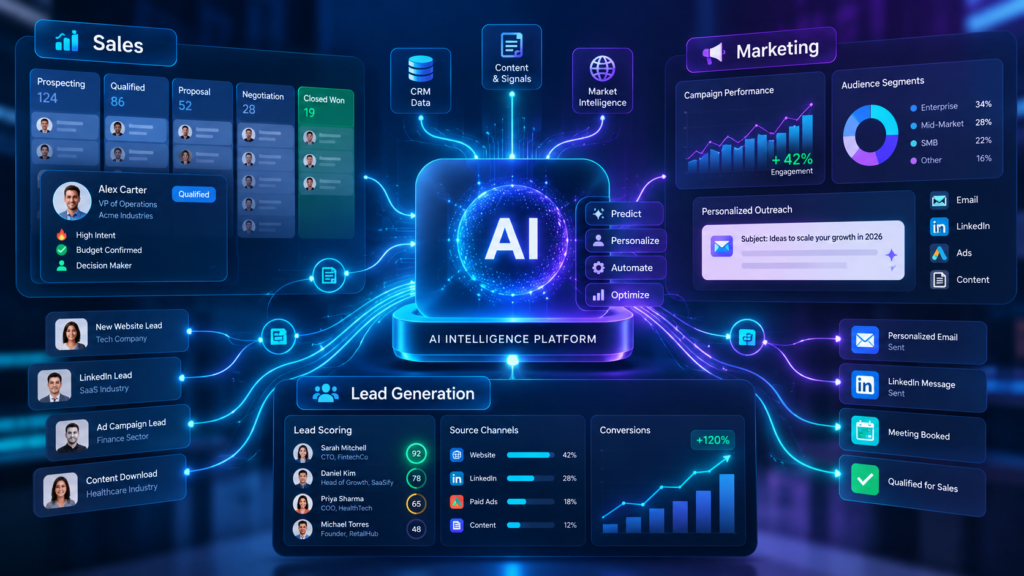
AI-Driven Sales, Marketing & Lead Generation is changing how companies find customers, understand buying interest, personalize campaigns, rank prospects, and move opportunities through the sales pipeline.
In the past, salespeople often spent hours researching companies, updating CRM records, sorting leads, and writing follow-up emails. Today, artificial intelligence can handle much of that early work. At the same time, marketing teams can use AI to study customer behavior, create campaign variations, identify promising audiences, personalize messages, and monitor performance.
As a result, businesses can work faster without removing people from the sales process.
In fact, the more practical model emerging in 2026 is a human-and-AI sales system. AI handles repetitive and data-heavy tasks, while sales and marketing professionals focus on strategy, relationships, negotiation, creativity, and decision-making.
This shift is already visible across major business platforms.
Research from McKinsey & Company shows that businesses are using AI for account intelligence, personalization, sales workflows, pricing, and proposal processes. Moreover, its B2B sales research suggests that companies can gain more value when AI is built into complete workflows instead of being used as a collection of separate tools.
Meanwhile, marketing is moving in the same direction. Platforms from Google, Adobe, Salesforce, HubSpot, and Microsoft are adding AI directly to advertising, analytics, CRM systems, prospecting, personalization, and customer-journey tools.
Therefore, the opportunity for businesses is significant. However, success still depends on accurate data, responsible automation, human oversight, and a clear understanding of where AI can improve the customer journey.
What Is AI-Driven Sales, Marketing & Lead Generation?
AI-Driven Sales, Marketing & Lead Generation refers to using artificial intelligence, machine learning, predictive analytics, generative AI, and AI agents to improve how businesses attract, identify, contact, qualify, convert, and retain customers.
Traditionally, these activities were handled separately.
For example, marketing teams created awareness and generated leads. Sales development teams then qualified those leads. After that, account executives managed opportunities, while CRM systems recorded the activity.
Today, AI can connect many of these stages.
For instance, an AI-enabled sales system could:
- Detect that someone visited several product pages.
- Combine that activity with existing CRM information.
- Estimate the person’s buying interest.
- Score the lead.
- Research the prospect’s company.
- Suggest which salesperson should contact the lead.
- Draft a personalized message.
- Recommend the next action.
- Summarize future conversations.
- Update the CRM automatically.
Clearly, this goes much further than traditional marketing automation.
Traditional automation usually follows simple rules:
If a customer does X, perform Y.
AI, on the other hand, can review many signals at the same time and make predictions based on patterns in data.
Generative AI adds another layer. For instance, it can create text, images, research summaries, advertisements, proposals, emails, and personalized content.
Meanwhile, agentic AI goes even further. An AI agent can complete several connected tasks toward a business goal while staying within limits set by the company.
How AI-Driven Sales, Marketing & Lead Generation Works
Modern AI sales and marketing systems usually combine several technologies.
1. Customer Data Collection
First, AI needs reliable information before it can provide useful recommendations.
Data may come from:
- CRM records
- Website activity
- Email engagement
- Advertising campaigns
- Sales calls
- Customer-support conversations
- Previous purchases
- Product usage
- Webinar registrations
- Contact forms
- Business databases
- Customer intent platforms
In other words, AI is only as useful as the information it receives.
For that reason, incomplete, duplicated, outdated, or poorly organized customer records can lead to weak recommendations.
2. Predictive Analytics
Predictive AI looks for patterns in past data.
For example, imagine that customers who eventually purchased a service often showed similar behavior before buying.
They may have:
- visited a pricing page several times,
- attended a webinar,
- downloaded a product guide,
- opened multiple sales emails,
- or worked at companies within a certain market segment.
Machine-learning models can compare new prospects with those patterns. As a result, they can identify leads that may be more likely to convert.
This process is one of the foundations of AI-powered lead scoring.
For example, Microsoft Dynamics 365 Sales includes sales intelligence features designed to help businesses understand and prioritize leads and opportunities.
3. Generative AI for Sales
Generative AI creates new content based on instructions and available information.
For sales and marketing teams, it can help draft:
- prospecting emails,
- advertisements,
- landing-page copy,
- product descriptions,
- meeting summaries,
- account briefs,
- proposals,
- follow-up messages,
- call scripts,
- social posts,
- campaign ideas.
For example, tools such as ChatGPT can support research, writing, analysis, summarization, and campaign planning.
However, the best results usually do not come from publishing every AI-generated draft automatically.
Instead, a stronger process is:
AI creates the first draft → a professional reviews it → the final version is approved and published.
This approach combines speed with human judgment.
4. AI Sales Prospecting
Traditional sales prospecting can take hours.
A salesperson may need to review company websites, professional profiles, industry databases, news reports, and CRM records before contacting a prospect.
Fortunately, AI can reduce much of that manual work.
For example, Salesforce Agentforce provides AI-agent capabilities within the Salesforce ecosystem.
Agentforce Prospecting can use CRM context, target accounts, contacts, emails, meetings, calls, and connected information sources to help generate and prioritize prospects.
As a result, sales representatives can spend less time gathering basic information and more time talking with customers.
Similarly, HubSpot Sales Hub combines CRM, automation, prospecting, and AI-assisted sales features to help teams manage pipelines and customer relationships.
5. AI Marketing Personalization
In the past, personalization often meant adding a customer’s first name to an email.
Today, AI personalization can go much further.
An AI system may review:
- browsing behavior,
- purchase history,
- customer interests,
- lifecycle stage,
- product usage,
- previous engagement,
- location,
- communication preferences.
Based on those signals, the system can help choose the most relevant message, product, content, or offer.
For example, Adobe Journey Optimizer is built around customer journeys, data, decision-making, and personalized experiences.
Therefore, businesses can move beyond basic mass marketing and create more targeted customer experiences.
6. AI Agents
AI agents are becoming one of the most important developments in modern sales technology.
Instead of waiting for a user to request every step, an AI agent may complete a sequence of approved tasks.
For example, a sales agent could:
- research an account,
- identify possible decision-makers,
- summarize recent company developments,
- review CRM history,
- prioritize an opportunity,
- prepare outreach,
- recommend follow-up actions.
Salesforce’s Agentforce Prospecting follows this model by supporting automated account research and prospect recommendations.
Likewise, Microsoft is adding AI and agent features across its Dynamics 365 business software ecosystem.
Nevertheless, human supervision remains important, especially when AI agents can contact customers or change important business records.
Why AI-Driven Sales and Marketing Matters
For many companies, the problem is not a lack of data.
Instead, the real challenge is having too much information and too little time to analyze it.
A salesperson may have hundreds of prospects but only enough time to study a small percentage of them properly.
Likewise, a marketing department may collect thousands or even millions of customer interactions across websites, advertisements, email campaigns, CRM systems, and support channels.
Because of this, AI can play an important role by turning those signals into priorities.
For example, McKinsey’s 2026 B2B sales research highlights how businesses are moving from isolated AI experiments toward broader commercial workflows supported by AI.
Therefore, the real advantage may not come from simply buying an AI tool.
Instead, it may come from building a better sales process around AI.
Main Benefits of AI in Sales, Marketing and Lead Generation
Faster Prospect Research
AI can review large amounts of information much faster than a salesperson working manually.
For example, before a sales meeting, a representative could receive a summary covering:
- company information,
- customer history,
- recent activity,
- possible needs,
- important contacts,
- recommended questions.
As a result, the salesperson can spend more time preparing for the actual conversation instead of searching through multiple sources.
In addition, faster research can help teams respond to leads while interest is still high.
Better Lead Prioritization
Not every lead deserves the same amount of attention.
AI-powered lead scoring can help identify prospects showing stronger buying signals.
Therefore, salespeople can focus more attention on leads that appear to have genuine potential.
However, AI scores should support decisions rather than control them completely.
Ultimately, human judgment still matters.
Personalized Outreach at Scale
A salesperson managing hundreds of prospects cannot realistically research and write hundreds of completely customized messages every week.
Fortunately, AI can help solve this problem.
For example, it can combine:
- prospect information,
- company information,
- CRM history,
- previous communication,
- industry context,
- product relevance.
Then, the system can prepare a personalized first draft.
Afterward, the salesperson can review and improve the message before sending it.
In this way, businesses can gain the speed of automation without losing human oversight.
Faster Content Production
Marketing teams constantly need new material.
This may include:
- emails,
- advertisements,
- landing pages,
- product descriptions,
- social posts,
- campaign variations,
- presentations,
- educational content.
Generative AI can speed up this process.
For instance, platforms such as ChatGPT Work can assist with research, analysis, and content creation.
Even so, AI-generated material should still go through editing, fact-checking, and brand review before publication.
As a result, businesses can save time while maintaining quality control.
Better Customer Insights
AI can also identify patterns that may be difficult for people to notice manually.
For example, customers who purchase Product A may often buy Product B several months later.
Likewise, prospects from one industry may respond strongly to webinars, while another group may prefer product demonstrations.
Because of these patterns, businesses can improve targeting and customer segmentation.
Moreover, better customer insights can help companies create more relevant offers and campaigns.
Automated CRM Administration
CRM systems are valuable only when the information inside them stays current.
Unfortunately, manually updating records takes time.
AI can help by:
- summarizing conversations,
- identifying action items,
- drafting CRM notes,
- organizing account information,
- recommending follow-ups.
Consequently, sales professionals can spend more time communicating with customers.
At the same time, managers can benefit from cleaner and more complete CRM records.
Major Risks and Limitations
AI can improve a good sales process. However, it can also make a poor process move faster.
For that reason, businesses need clear safeguards.
Poor Data Quality
AI depends on the information available to it.
Therefore, duplicate contacts, inaccurate details, outdated records, and incomplete CRM fields can produce weak recommendations.
Before introducing major AI automation, businesses should clean and organize their data.
Otherwise, even a powerful AI system may produce poor results.
AI Hallucinations
Generative AI can sometimes produce information that sounds correct but is not.
For example, AI could:
- misunderstand a customer,
- describe a company incorrectly,
- create an inaccurate product claim,
- misread an industry.
Because of this risk, important customer-facing information should be reviewed by a person before it is used.
In addition, businesses should verify important facts before sending proposals or publishing marketing content.
Over-Automation
Imagine receiving a personalized-looking sales email.
Soon afterward, another message arrives.
Later, a third appears.
Eventually, the customer realizes that the communication is mostly automated.
This is where AI can hurt a business.
Poorly managed automation creates more spam instead of better marketing.
Therefore, companies should use AI to improve relevance, not simply increase message volume.
Privacy and Data Governance
CRM and marketing platforms may contain sensitive customer information.
As a result, businesses need rules covering:
- what information can enter AI systems,
- how data is stored,
- who can access it,
- which automated actions are allowed,
- how customer information is protected.
The correct approach will depend on the company, industry, location, and type of data involved.
Furthermore, teams should understand which AI tools have permission to access customer information.
Algorithmic Bias
AI scoring systems learn from historical information.
However, historical patterns may contain biases or practices that should not shape future decisions.
Therefore, businesses should regularly review automated recommendations for unusual or unfair outcomes.
In addition, companies should avoid treating an AI-generated score as an unquestionable fact.
Loss of Human Connection
High-value sales often depend on trust.
For example, enterprise technology purchases, real estate transactions, consulting services, financial products, and other major decisions may require:
- negotiation,
- empathy,
- judgment,
- experience,
- personal relationships.
AI can help prepare a salesperson for these conversations.
However, it cannot automatically create genuine trust.
For this reason, human relationships remain essential in many complex sales environments.
Real-World AI Sales and Marketing Use Cases
B2B Prospecting
An enterprise software company can use AI to identify businesses that match its ideal customer profile.
First, the system can review CRM history, account details, previous engagement, and available intent signals.
Next, it can recommend priority prospects.
Finally, sales professionals can decide which opportunities deserve direct attention.
As a result, teams can spend less time searching and more time selling.
Real Estate Lead Management
A real estate brokerage may receive leads from Zillow, Google Ads, Facebook, websites, open houses, and referrals.
AI can help organize these leads by:
- location,
- budget,
- property preference,
- engagement,
- timeframe,
- readiness to buy.
As a result, agents can focus on stronger opportunities while automated nurturing continues for buyers who may need more time.
Meanwhile, long-term prospects can remain connected to the brokerage until they are ready to act.
E-Commerce Personalization
Online retailers can use browsing and purchase data to recommend products that may be more relevant to individual customers.
For example, Adobe Journey Optimizer and similar platforms help businesses coordinate personalized customer experiences across different channels.
Therefore, customers may receive more useful recommendations instead of generic promotions.
At the same time, retailers can use customer behavior to improve future campaigns.
Funnel Quality Control
AI can also identify weak points inside a marketing funnel.
For example, it may help detect:
- duplicate leads,
- incomplete records,
- sudden drops in conversion,
- poor-performing campaigns,
- weak follow-up processes.
Importantly, AI does not always need to create more content to provide value.
Sometimes, its greatest benefit is finding what is not working.
Consequently, businesses can improve the process before spending more money on advertising.
Advertising Optimization
Google Ads uses machine learning and AI across campaign creation, targeting, bidding, creative workflows, and optimization.
Businesses can also connect advertising activity with Google Analytics to better understand what customers do after clicking an advertisement.
As a result, marketers can make decisions using both campaign data and customer behavior.
Therefore, the role of the marketer is gradually shifting toward setting goals, reviewing recommendations, evaluating creative work, and controlling strategy.
At the same time, AI can handle more of the routine optimization work.
AI Tools, Platforms and Solutions
Businesses do not need to subscribe to every available AI tool.
Instead, a practical starting point is often the software already connected to company and customer data.
HubSpot
HubSpot combines CRM, marketing, sales, customer service, content management, and automation.
Its Sales Hub can support:
- prospect management,
- sales automation,
- CRM workflows,
- customer communication,
- pipeline management,
- AI-assisted selling.
Because these tools are connected within one ecosystem, HubSpot can be useful for growing companies that want sales and marketing functions working together.
In addition, a connected platform can reduce the need to move customer data between many separate systems.
Salesforce Agentforce
Salesforce is one of the world’s major CRM platforms.
Its Agentforce technology adds AI agents to business workflows.
For example, Agentforce Prospecting can research accounts, identify possible buyers, combine CRM information with connected data, and recommend prospects.
Therefore, the platform may be especially useful for organizations already using Salesforce heavily.
Moreover, companies can build AI workflows around customer information already stored in their CRM.
Microsoft Dynamics 365 Sales
Microsoft Dynamics 365 Sales combines CRM tools with Microsoft’s wider business software ecosystem.
Its AI-related sales features can support:
- account intelligence,
- CRM information,
- lead management,
- opportunity management,
- meeting preparation,
- sales productivity.
As a result, organizations already using Microsoft products may find the integration particularly useful.
In addition, familiar Microsoft tools can make adoption easier for existing business users.
Adobe Journey Optimizer
Adobe Journey Optimizer focuses more heavily on marketing, personalization, and customer journeys.
It helps organizations coordinate experiences across different channels.
Therefore, larger businesses managing complex customer interactions may use it to connect marketing data with customer experience decisions.
Similarly, companies can use customer signals to create more relevant experiences across multiple touchpoints.
Google Ads and Google Analytics
Google Ads remains one of the world’s most important online advertising platforms.
AI can assist with:
- campaign optimization,
- audience targeting,
- ad creation,
- automated bidding,
- campaign analysis.
Meanwhile, Google Analytics helps businesses measure website and app activity.
When used together, these platforms can help companies connect advertising results with customer behavior.
As a result, businesses can better understand which campaigns are attracting useful traffic.
ChatGPT
ChatGPT can support many sales and marketing tasks, including:
- market research,
- campaign brainstorming,
- prospect research,
- email drafting,
- content planning,
- summarization,
- data interpretation,
- proposal preparation.
In addition, OpenAI provides broader AI products and resources for businesses exploring generative AI.
However, businesses should still review important outputs before using them with customers.
AI Sales and Marketing Platform Comparison
| Platform | Best suited for | Main AI use cases | Key consideration |
|---|---|---|---|
| HubSpot | Small and growing businesses | CRM, prospecting, marketing automation, sales workflows | Strong sales and marketing integration |
| Salesforce Agentforce | Mid-market and enterprise companies | Prospect research, AI agents, CRM intelligence, pipeline workflows | Best suited to existing Salesforce environments |
| Microsoft Dynamics 365 Sales | Microsoft-centered businesses | CRM, account intelligence, opportunity management | Strong Microsoft ecosystem integration |
| Adobe Journey Optimizer | Enterprise marketing teams | Customer journeys, personalization, decision-making | More focused on marketing and customer experience |
| Google Ads and Google Analytics | Digital advertisers | Advertising, analytics, customer acquisition | Strong advertising and measurement tools |
| ChatGPT | Businesses of many sizes | Research, writing, analysis, summarization | Works best with human review and clear processes |
There is no single AI sales platform that is best for every company.
Instead, the right choice depends on your existing software, sales process, customer information, integrations, company size, and business goals.
Therefore, businesses should compare tools based on practical needs rather than choosing a platform simply because it includes AI.
Best Practices for AI-Driven Sales, Marketing & Lead Generation
Start With a Business Problem
Do not begin with:
“We need AI.”
Instead, start with a clear business problem.
For example:
“Our salespeople spend too much time researching unqualified prospects.”
Another example could be:
“Our marketing team cannot identify which leads deserve immediate sales attention.”
When the problem is clear, the AI project becomes easier to measure.
As a result, businesses can judge success based on real outcomes instead of technology alone.
Clean Your CRM Data
Good AI needs good information.
Before using advanced lead scoring or AI agents:
- remove duplicate contacts,
- standardize important fields,
- update customer information,
- identify missing records,
- establish clear data ownership.
Although data preparation may seem less exciting than generative AI, it is often more important.
After all, poor-quality data can lead to poor-quality recommendations.
Keep Humans in High-Stakes Decisions
AI should assist professionals rather than control every decision.
For example, people should remain responsible for:
- important customer relationships,
- unusual discounts,
- major contracts,
- legal claims,
- sensitive communications,
- reputation-sensitive campaigns.
Therefore, businesses should clearly define what AI can do on its own and when human approval is required.
In addition, employees should know when they are expected to review an AI-generated recommendation.
Measure Business Outcomes
Do not judge an AI project only by how much content it produces.
Instead, measure outcomes such as:
- qualified leads,
- meeting conversion rate,
- pipeline generated,
- sales cycle length,
- customer acquisition cost,
- revenue,
- retention,
- employee time saved.
After all, more automated emails do not automatically create more revenue.
Therefore, successful AI projects should connect automation to measurable business results.
Connect Marketing and Sales Data
One of the biggest opportunities comes from connecting the full customer journey.
For example, marketing knows what prospects read and click.
Meanwhile, sales teams understand what prospects ask during conversations.
Customer service teams know where customers struggle.
In addition, product teams know which features customers actually use.
When these signals are connected, AI gains much better context.
As a result, recommendations can become more useful across the entire customer journey.
Review AI Outputs Regularly
AI systems should not be installed and forgotten.
Instead, businesses should regularly review:
- recommendations,
- lead-scoring accuracy,
- generated communication,
- conversion performance,
- unusual activity,
- customer complaints.
As markets and customer behavior change, AI workflows should change as well.
Therefore, regular review is essential for maintaining quality.
Future Trends in AI Sales and Marketing
Agentic Sales Workflows
The next major shift is likely to be from AI assistants toward AI agents.
Instead of answering one question at a time, AI systems can increasingly manage connected workflows.
For example, an AI agent may research a prospect, review CRM history, prepare a summary, suggest outreach, and recommend the next step.
Therefore, the salesperson may increasingly become the strategist and supervisor behind these systems.
At the same time, routine research and administrative work may become more automated.
AI-to-AI Commerce
Customers are also starting to use AI assistants to research products and compare options.
This creates an interesting possibility.
In the future, a customer’s AI assistant may interact with a company’s AI systems before the customer talks directly with a salesperson.
As a result, companies may need to make their product information clear not only to people and search engines, but also to AI systems conducting research.
In addition, businesses may need to structure product details so AI assistants can understand them easily.
Continuous Marketing Optimization
Traditional campaigns often have a clear starting date and ending date.
AI-driven marketing can operate more continuously.
For example, AI systems can review:
- customer behavior,
- creative performance,
- engagement,
- conversion rates,
- advertising results,
- market changes.
Then, marketers can adjust campaigns much faster.
Therefore, marketing may become less about launching one campaign and more about continuously improving performance.
Over time, this could make campaign management more responsive to changes in customer behavior.
AI-Generated Customer Intelligence
Sales professionals may increasingly begin each day with an AI-generated briefing.
That briefing could include:
- priority accounts,
- new buying signals,
- changes in deal health,
- recommended contacts,
- suggested outreach,
- follow-up reminders.
Instead of searching through CRM records manually, salespeople could receive the most useful information automatically.
Consequently, teams may be able to respond more quickly to important opportunities.
Smaller Teams With Greater Capabilities
AI may also allow smaller businesses to perform work that once required larger specialist teams.
For example, a small company can use AI for:
- research,
- SEO,
- advertising,
- email marketing,
- lead qualification,
- CRM management,
- sales preparation,
- content creation.
However, this does not remove the need for skilled professionals.
Instead, it helps experienced people manage more work efficiently.
As a result, smaller companies may gain access to capabilities that were once easier for larger organizations to manage.
Frequently Asked Questions
1. How is AI used in sales and marketing?
AI can analyze customer information, prioritize leads, automate research, personalize marketing, generate content, summarize meetings, recommend next actions, optimize advertising, and support CRM management.
However, the best results usually come from combining AI tools with human sales and marketing expertise.
Therefore, businesses should treat AI as a tool that supports people rather than automatically replacing them.
2. Can AI generate qualified sales leads?
Yes. AI can help identify and prioritize potential customers using CRM information, past sales data, customer behavior, company details, and other useful signals.
However, it cannot guarantee that every recommended lead is truly qualified.
Therefore, human review remains important.
3. What is AI-powered lead scoring?
AI-powered lead scoring uses machine-learning models to estimate how likely a prospect is to complete a desired action.
For example, the system may estimate whether someone is likely to become a qualified lead or make a purchase.
Unlike simple rule-based scoring, predictive systems can review many variables at the same time.
As a result, sales teams can prioritize prospects more efficiently.
4. What are popular AI tools for sales and lead generation?
Popular platforms with AI-enabled sales or marketing features include HubSpot, Salesforce, Microsoft Dynamics 365, Adobe, Google Ads, and ChatGPT.
However, the best option depends on the company’s existing technology and sales process.
Therefore, businesses should compare platforms based on their actual workflow needs.
5. Will AI replace salespeople?
AI is more likely to change sales jobs than completely replace sales professionals.
For example, research, data entry, routine follow-ups, summaries, and some prospecting work can increasingly be automated.
However, complex sales still depend on:
- trust,
- negotiation,
- strategic thinking,
- industry knowledge,
- human relationships.
Therefore, the strongest sales teams will likely combine AI efficiency with human expertise.
6. What is the biggest risk of AI sales automation?
One major risk is scaling poor-quality communication.
For example, weak implementation can lead to inaccurate personalization, excessive outreach, privacy concerns, factual errors, or messages that damage customer trust.
For this reason, businesses should keep people involved in important customer communication.
In addition, companies should monitor automated campaigns for signs of poor quality or customer frustration.
7. Can small businesses use AI for lead generation?
Yes.
Small businesses can use platforms such as HubSpot, Google Ads, Google Analytics, and ChatGPT for research, lead management, content creation, advertising analysis, and customer follow-up.
However, it is usually better to begin with one clear workflow instead of adopting many tools at once.
As a result, the business can test what works before expanding its AI setup.
Conclusion
AI-Driven Sales, Marketing & Lead Generation is moving far beyond simple chatbots and automated emails.
Today, AI can connect CRM information, predictive analytics, generative AI, customer behavior, marketing automation, advertising data, prospect research, and AI agents into more complete sales workflows.
As a result, businesses can become faster and more efficient.
However, speed is not the main goal.
The greater opportunity is helping sales and marketing teams identify the right customers, understand them more clearly, communicate more effectively, and spend human time where it creates the most value.
Businesses that automate everything without clear oversight may simply create more noise.
In contrast, companies that combine accurate data, responsible automation, strong AI governance, human expertise, and genuine customer relationships are better positioned to benefit.
Therefore, the future of sales is unlikely to be AI versus humans.
Instead, it is becoming AI working alongside skilled people to create smarter, faster, and more responsive businesses.
Overall, the companies that benefit most will likely be those that use AI to improve the customer experience rather than simply automate more tasks.
SEO Publishing Package
Primary keyword:
AI-Driven Sales, Marketing & Lead Generation
Secondary keywords:
- AI lead generation
- AI sales automation
- AI marketing automation
- AI-powered lead scoring
- generative AI for sales
- AI sales prospecting
- AI customer personalization
- AI CRM tools
SEO title:
AI-Driven Sales, Marketing & Lead Generation: Complete 2026 Guide
Meta description:
Discover how AI-Driven Sales, Marketing & Lead Generation helps businesses automate prospecting, score leads, personalize marketing, improve CRM workflows, and grow smarter in 2026.
URL slug:ai-driven-sales-marketing-lead-generation
Suggested categories:
Artificial Intelligence, Business Technology, Sales & Marketing, AI Tools
Suggested tags:
AI Lead Generation, AI Sales, Marketing Automation, Generative AI, Sales Automation, AI CRM, Lead Scoring, AI Marketing, Agentic AI, Business AI
Featured-Image Idea
Create a professional editorial-style technology image showing a central AI platform connected to three business areas:
Sales → Marketing → Lead Generation
Include:
- CRM customer profiles
- lead-scoring indicators
- marketing analytics
- sales pipeline stages
- personalized emails
- conversion charts
- AI-agent connections
Use a clean business-technology style rather than a futuristic robot.
Featured-image alt text:
AI-Driven Sales, Marketing & Lead Generation platform analyzing leads, CRM data, marketing campaigns and sales opportunities
Suggested image title:
AI-Driven Sales, Marketing & Lead Generation 2026
Suggested caption:
AI is connecting sales, marketing, customer data and lead generation into increasingly automated business workflows.
Suggested image description:
Professional technology illustration representing AI-driven sales, marketing automation, CRM intelligence, predictive lead scoring and automated lead generation.
Internal-Linking Opportunities for TechWaveDigest
Link these sections to related articles on TechWaveDigest:
1. AI Tools for Business
Link from the section discussing AI platforms and business productivity.
2. 5 AI Tools I Use Every Morning Before 9 AM
Link from the section about practical AI workflows.
3. How AI Will Change Jobs in the Next 10 Years
Link from the future-of-work discussion.
4. The Skills You MUST Learn to Stay Relevant in an AI World
Link from the section about human judgment and AI supervision.
5. AI-Driven Property Valuation and Automated Real Estate Market Analysis Platforms
Link from the real estate lead-management example.
Affiliate Opportunities
Affiliate links should only be added when they genuinely help readers compare software.
Natural opportunities include:
CRM platforms:
Review and compare HubSpot, Salesforce, and Microsoft Dynamics 365.
Marketing and SEO platforms:
Create separate comparison articles covering AI marketing, analytics, SEO, and campaign tools.
Email marketing and automation:
Affiliate links can fit naturally into articles comparing lead-nurturing and email-automation platforms.
Business AI tools:
Publish hands-on reviews before recommending products commercially.
Strong commercial articles for TechWaveDigest could include:
Best AI Sales Tools for Small Businesses in 2026
Best AI Lead Generation Software in 2026
Best AI CRM Platforms Compared
Best AI Marketing Automation Tools
These comparison articles are better places for affiliate links because readers are closer to making a purchase.
Finally, always confirm that an affiliate program is active before publishing a promotional link.
Curated by the TechWave Digest Research Team