
Introduction
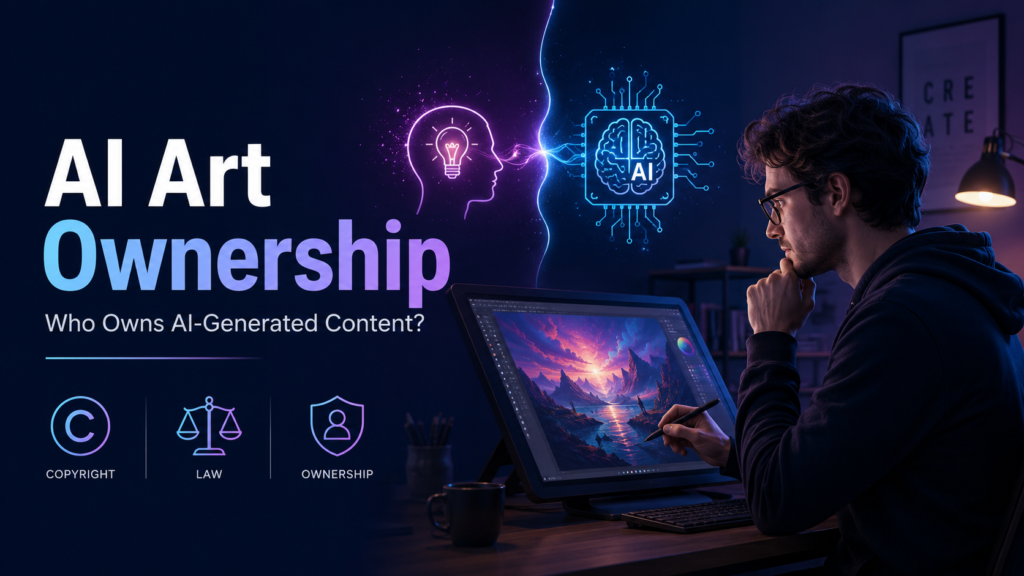
AI art ownership determines who can use, sell, license, copy, or protect content created with artificial intelligence.
However, the person who enters a prompt does not always own every legal right to the result.
Instead, ownership usually depends on four main factors:
- The amount of original human creativity in the final work
- The copyright law of the relevant country
- The AI platform’s terms and conditions
- Any third-party rights connected to the output
In the United States, purely AI-generated material is generally not protected by copyright because copyright requires human authorship. However, original writing, editing, arrangement, illustration, or other creative work added by a person may receive protection.
At the same time, an AI platform may state that the user owns the generated output. Even so, that promise does not automatically create copyright under national law.
Therefore, a creator may have permission to sell an AI image without having an enforceable copyright over the image itself.
This difference is central to understanding AI art ownership.
Businesses must consider copyright, commercial permissions, platform contracts, trademarks, personality rights, and the chance that another user could receive a similar result.
Creators who want to understand the technology behind these outputs can also read TechWaveDigest’s guide to the best AI image generators in 2026.
Important: This article provides general educational information and is not legal advice. Copyright results depend on the country, facts, contract, platform, and creative process.
What AI Art Ownership Means
AI art ownership can describe several different rights. Therefore, these rights should not be treated as the same thing.
Copyright ownership
Copyright protects original creative expression.
For example, it may protect:
- Articles
- Illustrations
- Photographs
- Music
- Videos
- Software
- Graphic designs
- Creative arrangements
A copyright owner may have the right to reproduce, publish, distribute, display, adapt, sell, or license a protected work.
However, owning an AI-generated file does not automatically mean the content qualifies for copyright protection.
Contractual ownership
When a person creates content through an AI platform, the platform’s terms control the relationship between the user and the company.
For instance, the terms may state that:
- The user owns the output
- The company assigns its rights to the user
- Commercial use is allowed
- The platform keeps a limited licence
- Outputs may not be unique
- Certain subscription plans are required
These are contractual rights.
In other words, they explain what the platform claims against the user. They do not force a court or copyright office to recognise copyright in the output.
Commercial-use permission
Commercial permission allows the user to use an output for business purposes.
These uses may include:
- Advertising
- Books
- Websites
- Social-media campaigns
- Merchandise
- Client projects
- Presentations
- Product packaging
However, commercial permission does not guarantee that the output is copyrightable, exclusive, or free from third-party claims.
Ownership of the digital file
A person may own a downloaded file without owning copyright in the content.
For example, someone may own a printed painting but not have the right to reproduce and sell copies of the artwork.
The same principle applies to AI-generated files.
Third-party rights
An AI output may contain or resemble protected material owned by someone else.
Possible issues include:
- Copyrighted characters
- Brand logos
- Trademarks
- Celebrity likenesses
- Protected photographs
- Trade dress
- Existing illustrations
- Confidential information
Therefore, a platform’s ownership clause does not remove third-party rights.
How AI Art Ownership Works
The legal position can be understood through six stages.
Step 1: Determine who owns the input
The input may include:
- A written prompt
- An uploaded photograph
- A sketch
- A company logo
- A manuscript
- A recording
- A product design
- A reference image
First, the user should own the input or have permission to use it.
Uploading another creator’s work does not automatically provide permission to create and sell an adaptation.
OpenAI’s current terms require users to have the rights, licences, and permissions needed for submitted material. In addition, users remain responsible for ensuring that their content does not violate the law or another person’s rights.
Review OpenAI’s official Terms of Use.
Step 2: Read the platform’s ownership terms
Many AI providers assign their interest in an output to the user.
However, the terms often include phrases such as:
- “As between you and the company”
- “To the extent permitted by law”
- “Subject to third-party rights”
- “Subject to your subscription plan”
- “Outputs may not be unique”
These limits are important.
Essentially, the platform is explaining its own legal position. It is not promising that a court or copyright authority will treat the user as the legal author.
Step 3: Separate human and AI-generated elements
A completed project may contain both human-created and AI-generated material.
For example, a creator may:
- Write an original story.
- Generate background images with AI.
- Select and arrange those images.
- Repaint the characters.
- Add original typography.
- Design the final page layout.
In this case, the human-written story, original edits, typography, and creative arrangement may receive protection.
However, the unchanged AI-generated sections may receive different treatment.
The U.S. Copyright Office states that copyright may protect original human expression within an AI-assisted work. By contrast, it does not protect material created entirely by AI without enough human control.
Read the U.S. Copyright Office’s AI copyrightability report.
Step 4: Assess human creative control
A short prompt may express an idea without controlling the exact final image.
For example:
Create a cinematic futuristic city at sunset.
The user chooses the subject and overall direction. However, the model may decide:
- Building shapes
- Camera angle
- Lighting
- Colour placement
- Character appearance
- Textures
- Object positions
- Composition
Under the current U.S. Copyright Office position, prompts alone usually do not provide enough control over the expressive details to establish authorship.
However, the human contribution becomes stronger when the person edits, arranges, rewrites, combines, paints, or otherwise controls the final expression.
This difference is also discussed in TechWaveDigest’s comparison of AI and human intelligence.
Step 5: Review employment and client agreements
Even when a human contribution qualifies for copyright, contracts may decide who receives those rights.
Relevant agreements include:
- Employment contracts
- Freelance contracts
- Agency agreements
- Commission agreements
- Publishing contracts
- Intellectual-property assignments
- Work-made-for-hire agreements
For example, a designer creating an AI-assisted advertisement for a client should clarify:
- Who owns the human-created elements
- Whether editable files are transferred
- Whether prompts may be reused
- Whether the final design is exclusive
- Which third-party assets are included
- Who accepts infringement risk
- Whether the designer may show the work in a portfolio
Therefore, payment alone does not always transfer every intellectual-property right.
Step 6: Check third-party restrictions
A creator may own the original layout of a poster while still infringing a trademark used inside it.
Likewise, commercial permission from an AI platform does not remove another person’s privacy or publicity rights.
As a result, ownership does not provide unlimited permission to use an output in every situation.
AI Art Ownership Across Different Countries
AI art ownership varies because copyright law is territorial.
Therefore, the same work may receive protection in one country but not another.
United States
The United States requires human authorship.
The U.S. Copyright Office’s 2025 report explains that:
- Purely AI-generated material is not protected
- Human-created expression may be protected
- Human selection and arrangement may qualify
- Creative human changes may qualify
- Each case must be reviewed separately
- Prompts alone usually provide too little control
In March 2025, the U.S. Court of Appeals for the District of Columbia Circuit upheld the refusal to register an image that named an AI system as the sole author.
The court concluded that the Copyright Act requires eligible work to be created initially by a human.
Read the official court decision.
However, this does not mean every project involving AI is unprotected.
Human-written content, original edits, creative arrangements, and other independent human contributions may still receive copyright protection.
United Kingdom
The United Kingdom currently recognises certain computer-generated literary, dramatic, musical, and artistic works.
Under the existing law, the person who makes the arrangements needed to create the work may be treated as the author.
However, this system was introduced before modern generative AI.
As a result, the UK government has questioned whether the current framework works clearly for today’s technology.
Its copyright and AI consultation, updated in March 2026, requested views on possible reforms.
Read the UK government consultation.
Therefore, users should not assume that entering a prompt automatically makes them the legal author under UK law.
European Union
The European Union does not have a simple rule that gives copyright ownership of every AI output to the user.
Instead, EU copyright normally depends on original creative choices made by a human author.
A 2025 European Parliament study found that works created entirely by machines without human creative involvement generally do not qualify for copyright protection under the current framework.
However, hybrid human-AI works remain an area of legal uncertainty.
Read the European Parliament study on generative AI and copyright.
The EU AI Act also creates duties for certain AI providers. Nevertheless, those rules do not automatically decide who owns an individual output.
India
India’s Copyright Act states that the author of a computer-generated literary, dramatic, musical, or artistic work is the person who causes the work to be created.
Read India’s official Copyright Act.
However, this wording was introduced before today’s generative AI platforms.
Questions remain when:
- A user writes only a short prompt
- Several people contribute
- A company owns the account
- An employee operates the tool
- The model makes most creative decisions
- The result resembles another work
Therefore, modern AI ownership questions in India should be examined carefully and individually.
Why AI Art Ownership Matters
AI art ownership affects whether an output can become a dependable commercial asset.
Exclusivity
A company may want to prevent competitors from copying its:
- Mascot
- Packaging
- Campaign image
- Website design
- Book illustration
- Product artwork
- Educational content
However, if the main image is purely AI-generated and receives no copyright protection, stopping others from copying it may be difficult.
Licensing revenue
Creators often earn money by licensing:
- Stock images
- Music
- Videos
- Illustrations
- Book covers
- Marketing graphics
- Templates
- Educational materials
However, a buyer may avoid paying for an exclusive licence if the seller cannot show that enforceable exclusive rights exist.
Client contracts
Agencies and freelancers often promise that the client will own the completed work.
Nevertheless, that promise becomes risky when the project contains AI-generated material with uncertain legal protection.
Therefore, contracts should state clearly which rights are being transferred.
Company valuation
Intellectual property may contribute to a company’s value.
Investors may ask:
- Who created the asset?
- Which AI platform was used?
- Which subscription plan applied?
- Is the asset copyrightable?
- Can it be licensed?
- Is it exclusive?
- Were third-party materials included?
Poor documentation can create problems during legal or investment reviews.
Enforcement
A creator usually needs a legally recognised right before preventing someone else from copying a work.
Therefore, possessing the file or receiving rights from a platform may not be enough when copyright never existed.
Benefits of Human-Led AI Creative Work
Faster concept development
AI can help creators explore several visual, musical, or written ideas before choosing one.
As a result, the early creative process may become faster.
Lower production barriers
Independent creators and small businesses can test ideas without building a large production team.
However, professional review may still be needed before commercial release.
Easier experimentation
Creators can compare:
- Alternative compositions
- Different writing tones
- Colour directions
- Story structures
- Advertising concepts
- Product ideas
Therefore, AI can support creative exploration without requiring every idea to be built manually.
Greater personalisation
AI can adapt content for a specific audience, campaign, language, or platform.
For example, one design may be adjusted for a social post, website banner, and printed advertisement.
Support for human creativity
AI may assist with brainstorming, drafts, backgrounds, variations, and repetitive editing.
However, a human-led workflow usually provides stronger creative control and a clearer record of authorship.
TechWaveDigest’s article about human-AI collaboration in creative work explores this relationship further.
Major AI Art Ownership Risks
No enforceable copyright may exist
A platform may say the user owns the output. However, national law may refuse copyright protection because the content lacks human authorship.
As a result, the user may be able to sell the image but remain unable to stop someone else from copying it.
AI output may not be unique
Several users may receive the same or similar outputs.
For example, OpenAI’s terms state that outputs may not be unique and that other users may receive similar material.
Jasper’s agreement contains a similar warning.
Therefore, creators should avoid promising that an AI-generated asset is completely unique unless they can support that claim.
Outputs may resemble protected content
An output may accidentally resemble an existing:
- Illustration
- Character
- Photograph
- Brand logo
- Film franchise
- Product design
- Celebrity likeness
The risk may increase when a prompt requests a copyrighted character or another creator’s exact style.
Therefore, human review remains necessary.
Commercial permission does not guarantee safety
A platform may allow commercial use without guaranteeing that the output is:
- Copyrightable
- Unique
- Non-infringing
- Free of trademarks
- Free of personality-right claims
- Appropriate in every country
In other words, commercial permission and legal clearance are different things.
Platform terms may change
AI companies regularly update:
- Ownership clauses
- Privacy policies
- Commercial-use rules
- Subscription requirements
- Indemnification conditions
- Training policies
Therefore, businesses should save the version of the terms and plan that applied when important content was produced.
Confidential material may be exposed
Creators should avoid uploading trade secrets, private manuscripts, client documents, or unreleased products without reviewing the platform’s data policies.
In addition, companies should use approved business accounts for sensitive work.
International rights may conflict
An AI-assisted work may receive protection in one country but not another.
Consequently, global licensing, ecommerce, publishing, and enforcement can become more complicated.
Real-World AI Art Ownership Examples
Example 1: A single prompted image
A user enters:
Create a colourful dragon flying over a futuristic city.
The platform creates one image, and the user publishes it without editing.
Although the platform may assign its rights to the user, the image may lack U.S. copyright protection because the model created most of the expressive details.
Example 2: A heavily edited illustration
An illustrator generates a rough AI image and then:
- Repaints the characters
- Changes the composition
- Adds original architecture
- Corrects the lighting
- Draws new objects
- Combines the image with original sketches
In this case, the artist may own copyright in the original human changes and arrangement.
However, protection may not extend to every unchanged AI-generated element.
Example 3: An AI-assisted article
A writer uses AI to create an outline and a rough draft.
Afterward, the writer:
- Conducts original research
- Checks sources
- Rewrites every section
- Adds personal analysis
- Changes the structure
- Develops an original argument
As a result, the finished article may contain substantial human-authored expression.
The writer should also preserve drafts and revision records.
Example 4: A client advertisement
An employee uses AI to create an image, writes the headline, edits the layout, and prepares a final advertisement.
Ownership may depend on:
- Platform terms
- Employment agreements
- Client contracts
- Human creative contribution
- Stock assets
- Local law
Therefore, the agency-client agreement should explain exactly which rights are transferred.
Example 5: Print-on-demand products
A seller creates AI graphics for posters and clothing.
Even when commercial use is allowed, the seller should check for:
- Copyrighted characters
- Trademarks
- Celebrity likenesses
- Existing similar designs
- Marketplace rules
- Subscription requirements
Example 6: An AI-generated logo
A business should be careful when relying on a purely AI-generated logo.
The logo may not receive copyright protection. In addition, it could resemble an existing brand.
However, trademark protection may still be possible if the logo identifies the company’s products or services.
Therefore, a proper trademark search is advisable.
Platform Terms and AI Art Ownership
OpenAI
OpenAI’s terms state that, as between the user and OpenAI and to the extent permitted by law, the user owns the output.
OpenAI also assigns any rights it may have in that output to the user.
However, the terms warn that outputs may not be unique.
Review OpenAI’s current Terms of Use.
Main limitation: Contractual ownership does not guarantee copyright protection or exclusivity.
Adobe Firefly
Adobe states that, between Adobe and an enterprise customer, the customer owns and controls Firefly output, subject to the agreement and input restrictions.
However, Adobe also explains that copyright ownership depends on the law of the customer’s country.
Review Adobe’s official Firefly legal FAQ.
Main limitation: Adobe’s contract cannot decide whether national law recognises copyright.
Midjourney
Midjourney’s terms state that users own assets they create to the fullest extent possible under applicable law.
However, the terms include limits related to:
- Third-party rights
- Other users’ images
- Subscription plans
- Large-company use
Review Midjourney’s official Terms of Service.
Main limitation: Ownership remains subject to local law, plan conditions, and third-party rights.
Jasper
Jasper’s business agreement treats customer input and output as customer property.
It also assigns any Jasper rights that do not automatically belong to the customer.
However, the agreement warns that similar output may be generated for other users.
Review Jasper’s Software as a Service Agreement.
Main limitation: A contract cannot create copyright if the legal requirements are not met.
Canva
A Canva design may combine:
- User-uploaded content
- AI-generated material
- Templates
- Stock photographs
- Licensed graphics
- Fonts
Therefore, each part may have different rights and restrictions.
Users should review Canva’s AI Product Terms and the licence applying to each asset.
Main limitation: A completed design may contain several layers of ownership and licensing.
Content Credentials
Content Credentials use standards developed by the Coalition for Content Provenance and Authenticity.
They can record verifiable information about how digital content was created or changed.
Review the C2PA technical standard.
However, Content Credentials do not create copyright.
Instead, they provide evidence about origin and editing history.
IMAGE 2 — Add before the comparison table
Alt Text: AI art ownership comparison covering OpenAI, Adobe Firefly, Midjourney, Jasper, Canva, and copyright protection
Caption: Comparing AI Platform Terms and AI Art Ownership
Image Description: A clean comparison graphic showing leading AI platforms beside columns for output ownership, commercial use, uniqueness, copyright protection, and third-party rights.
AI Art Ownership Platform Comparison
| Platform | Contract position | Important qualification | Copyright guaranteed? |
|---|---|---|---|
| OpenAI | User owns output as between the parties | Output may not be unique, and ownership applies only where permitted by law | No |
| Adobe Firefly | Customer owns and controls output between the parties | Local law determines copyright protection | No |
| Midjourney | User owns created assets where legally possible | Plan conditions and third-party rights apply | No |
| Jasper | Output is treated as customer property | Similar outputs may be generated for others | No |
| Canva | Users retain their own content and designs | Licensed assets remain subject to separate rules | No |
| Content Credentials | Records origin and editing history | Evidence does not create legal ownership | No |
Best Practices for Stronger AI Art Ownership
Keep humans involved
Use AI for:
- Ideas
- Drafts
- Variations
- Background elements
- Repetitive editing
However, let a person control:
- Composition
- Structure
- Wording
- Arrangement
- Character design
- Selection
- Final presentation
Save evidence of human creativity
Preserve:
- Original sketches
- Human-written drafts
- Prompt history
- Generated versions
- Editing files
- Layered source files
- Revision notes
- Dates
- Approval records
These materials may help show how much human creativity shaped the final work.
Begin with original human material
Using original drawings, photographs, music, or writing as input may provide stronger rights in those elements.
Therefore, original source material should be saved separately.
Make meaningful creative changes
Minor resizing or colour correction may not add enough original expression.
Instead, meaningful changes may include:
- Repainting important sections
- Rewriting text
- Rearranging elements
- Combining several assets creatively
- Adding original characters
- Designing a distinctive layout
- Changing the narrative structure
Record the platform terms
Document:
- Platform name
- Subscription plan
- Generation date
- Terms version
- Commercial permissions
- Privacy settings
- Indemnification conditions
As a result, the business will have a clearer record if the terms later change.
Check third-party rights
Before important commercial use, examine the output for:
- Logos
- Protected characters
- Recognisable people
- Existing artwork
- Trademarked designs
- Stock restrictions
- Confidential information
Use clear contracts
Client and employment agreements should address:
- AI use
- Human contributions
- Copyright ownership
- Licensing
- Exclusivity
- Disclosure
- Liability
- Third-party assets
- Recordkeeping
Disclose AI material when registering copyright
In the United States, applicants should identify AI-generated sections when registering a mixed human-AI work.
They should also explain the original human contribution.
The Copyright Office may then register the protected human expression while excluding the AI-generated material.
Use provenance tools
Content Credentials and editing records can help show how a work was created.
However, they should support legal records rather than replace them.
Detection systems may also help identify synthetic content, although they should not be treated as perfect evidence.
See TechWaveDigest’s guide to the best AI detector tools.
Future of AI Art Ownership
More court decisions
Courts will continue examining how much human control is needed for protection.
Future cases may distinguish between simple prompts and advanced workflows involving:
- Layers
- Inpainting
- Reference control
- Manual editing
- Object placement
- Precise composition
Legal reform
Countries may update laws that were created before modern generative AI.
For example, the United Kingdom is reviewing its rules for computer-generated works.
Stronger provenance systems
Content Credentials and similar systems will improve records of AI involvement and editing history.
However, provenance and copyright ownership will remain separate ideas.
Greater creative control
AI platforms are giving users more control over:
- Individual objects
- Camera angles
- Typography
- Layers
- Colour
- Poses
- Timing
- Music structure
As a result, greater human control may strengthen authorship arguments in some cases.
Automated rights management
Future AI tools may help businesses:
- Record platform terms
- Track source files
- Flag trademark risks
- Store licensing information
- Maintain approval records
- Identify AI-generated sections
These functions may connect with the governance tools discussed in TechWaveDigest’s guide to the best AI agent platforms.
More licensing markets
New markets may develop for:
- Artist-approved AI models
- Licensed training data
- Synthetic voices
- AI stock media
- Brand-specific models
- Character assets
- Commercial prompt libraries
Frequently Asked Questions About AI Art Ownership
What does AI art ownership mean?
AI art ownership describes the legal and contractual rights connected to an AI-generated or AI-assisted work.
It may include copyright, commercial-use permission, file ownership, licences, platform rights, and third-party restrictions.
Who owns AI-generated artwork?
The platform’s terms may assign output rights to the user.
However, legal copyright ownership depends on the country and the amount of original human creative input.
Can AI-generated content be copyrighted?
Purely AI-generated material is generally not copyrightable in the United States.
However, original human writing, editing, selection, arrangement, and creative changes may qualify for protection.
Does writing a prompt create copyright?
Not automatically.
The U.S. Copyright Office currently considers prompts insufficient in most cases because they do not control the exact expressive details of the final result.
Can AI-generated art be sold commercially?
It can often be sold when the platform’s terms allow commercial use.
However, the seller must still consider copyright, trademarks, publicity rights, marketplace rules, subscription limits, and third-party material.
Does the AI company own the output?
Many leading platforms state that the user owns the output or receives any rights the company may have.
However, the wording and conditions differ between services.
How can creators protect AI-assisted content?
Creators should add meaningful human expression, preserve drafts and source files, review platform terms, use written contracts, check third-party rights, and register eligible human-created elements.
Conclusion: Understanding AI Art Ownership
AI art ownership does not have one universal answer.
An AI platform may assign contractual output rights to the user. However, copyright law may protect only the original human-created sections of the finished work.
In the United States, purely AI-generated content is generally not copyrightable. By contrast, meaningful human writing, editing, selection, arrangement, and modification may receive protection.
The United Kingdom, European Union, India, and other regions may apply different legal approaches.
Therefore, creators must also consider:
- Platform terms
- Employment agreements
- Client contracts
- Third-party rights
- Commercial permissions
- Trademark law
- International differences
The strongest approach is a human-led creative process.
Use AI for ideas, drafts, variations, and support. Then apply meaningful human decisions through writing, editing, composition, arrangement, and final presentation.
In addition, document the process, retain layered source files, record the relevant platform terms, and avoid promising exclusivity that cannot be proved.
AI can accelerate creativity. However, reliable AI art ownership still depends on human contribution, clear agreements, and responsible rights management.
Curated by the TechWave Digest Research Team