
Cybersecurity has always been a game of cat and mouse. Malware developers discover a new way into a system, security companies learn how to detect it, and attackers quickly change their methods.
Now, artificial intelligence is making that familiar battle much faster.
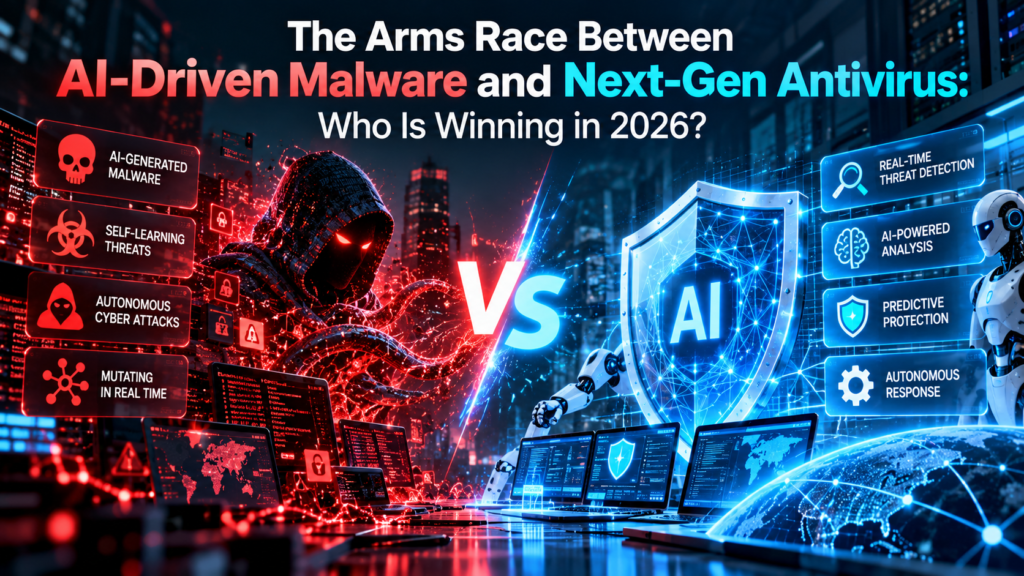
The Arms Race Between AI-Driven Malware and Next-Gen Antivirus is no longer just a futuristic idea. Attackers are already using AI to research targets, improve phishing messages, modify malicious code, automate parts of an attack, and make malware more flexible.
At the same time, security companies are using machine learning, behavior analysis, cloud-based threat intelligence, endpoint monitoring, and automated response tools to detect attacks that may never have been seen before.
So, who is winning?
For now, neither side has a permanent advantage. Instead, the real competition is about who can recognize a threat, adapt, and respond faster.
That difference is important.
Recent cybersecurity research shows that criminal and state-backed groups are increasingly using AI to improve existing attack methods. However, most attackers are still using AI as a powerful assistant rather than relying on completely autonomous malware.
Meanwhile, researchers at Google Threat Intelligence have started documenting something more advanced: malware and threat operations that can use large language models as part of an active attack workflow.
In other words, attackers and defenders are both learning how to use AI to make faster decisions.
As a result, the rules of cybersecurity are changing.
What Is the Arms Race Between AI-Driven Malware and Next-Gen Antivirus?
The Arms Race Between AI-Driven Malware and Next-Gen Antivirus describes the growing competition between attackers who use AI to improve malicious software and defenders who use AI-powered security tools to identify and stop those attacks.
To understand the battle, it helps to look at both sides separately.
What Is AI-Driven Malware?
AI-driven malware is malicious software that uses artificial intelligence during its development, targeting, operation, or modification.
However, this does not usually mean that an independent AI system is wandering around the internet and hacking computers on its own.
In most cases today, AI works more like a very fast assistant for the attacker.
For example, criminals may use AI to:
- Write or debug malicious scripts
- Research software weaknesses
- Modify code to avoid basic detection
- Generate phishing emails
- Translate scams into different languages
- Collect information about potential targets
- Create realistic fake identities
- Analyze compromised systems
- Generate commands during an attack
- Adjust attack methods based on what is discovered
Major security organizations, including Google Threat Intelligence and OpenAI, have documented threat actors using generative AI during cyber operations.
For instance, attackers have used AI while developing malware, troubleshooting code, researching targets, and creating infrastructure for malicious campaigns.
Therefore, AI is already making some parts of cybercrime faster and easier.
What Is Next-Generation Antivirus?
Traditional antivirus software became well known for detecting malware through signatures.
A malware signature is similar to a digital fingerprint.
If antivirus software recognizes the fingerprint of a known malicious file, it can block or remove it.
That method is still useful. However, modern malware can change so quickly that signatures alone are no longer enough.
Next-generation antivirus, or NGAV, adds more advanced security technologies, including:
- Machine learning
- Behavior monitoring
- Heuristic analysis
- Cloud threat intelligence
- Memory scanning
- Exploit prevention
- Anomaly detection
- Automated containment
Instead of asking only:
“Have we seen this exact file before?”
modern security systems also ask:
“What is this program actually doing?”
That change is important because a new malicious file may look unfamiliar while still behaving like known malware.
For example, Microsoft Defender for Endpoint combines endpoint protection with detection, investigation, automated response, and other security capabilities.
As a result, modern antivirus platforms may identify some threats even when the exact malicious file has never been seen before.
How the AI Malware vs. Antivirus Arms Race Works
Imagine a burglar who changes clothes, hairstyle, voice, and identity every time a camera recognizes them.
Now imagine that the security system stops focusing only on appearance. Instead, it learns to recognize suspicious behavior.
That is similar to what is happening in modern cybersecurity.
Stage 1: Attackers Change the Malware
Older malware often contained predictable pieces of code.
Security researchers could study the malware, identify those patterns, and then create detection rules.
Attackers responded by changing the code.
One long-used technique is called polymorphism.
Polymorphic malware changes parts of its code while keeping the same harmful purpose. Therefore, each new version can look slightly different from the previous one.
AI may make this process faster.
Instead of manually creating many malware versions, attackers can use AI tools to rewrite, hide, or generate parts of the code.
Consequently, defenders may have less time to study one version before another appears.
Stage 2: Antivirus Focuses on Behavior
Next-generation security software does not look only at the file itself.
It also watches what the program does.
For example, imagine an unfamiliar application that suddenly:
- Opens Microsoft PowerShell
- Tries to disable security tools
- Reads saved browser passwords
- Creates a hidden startup process
- Connects to an unusual server
- Starts encrypting hundreds of files
PowerShell itself is a legitimate Microsoft command-line and scripting tool used for administration and automation. The problem begins when criminals abuse legitimate tools for malicious purposes.
The malicious file may be completely new.
However, its actions may still be highly suspicious.
Behavior-based security tools can detect a chain of unusual activity even when the exact malware has never appeared in a signature database.
Therefore, next-generation protection can sometimes stop new threats before traditional antivirus catches up.
Stage 3: Attackers Try to Look Normal
Unfortunately, attackers understand how behavior-based detection works.
As a result, advanced groups increasingly use legitimate system tools instead of installing obvious malicious programs.
This technique is sometimes called living off the land.
For example, attackers may misuse:
- PowerShell
- Command-line utilities
- Remote administration software
- Scheduled tasks
- Built-in Windows security and administration tools
These tools are legitimate and often necessary.
However, criminals can also use them for harmful purposes.
Therefore, modern security systems need context.
They must understand not only which tool is being used but also who is using it, why it is being used, and what happens next.
Why the AI Malware Arms Race Matters
The biggest change AI brings to cybersecurity is not simply smarter malware.
It is speed.
A human attacker has limited time and attention. However, AI can automate repetitive parts of an attack.
A human security analyst also has limits. On the defensive side, AI can review large amounts of security information far faster than a person.
As a result, both sides are trying to reduce the time needed to act.
Tasks that once took hours may take minutes. Likewise, work that once required minutes may happen within seconds.
This matters because cybersecurity often depends on timing.
If defenders recognize an attack early, they may stop it before important systems are affected.
On the other hand, if attackers move faster than security teams can respond, they may steal data, spread ransomware, or take over accounts before anyone notices.
Therefore, AI is becoming part of the basic infrastructure of both cyberattack and cyber defense.
Main Benefits of AI-Powered Next-Gen Antivirus
AI-driven attacks sound worrying. Fortunately, artificial intelligence also gives defenders powerful new tools.
1. Detecting Previously Unknown Threats
Signature-based antivirus works best when researchers already know what a malicious file looks like.
Machine-learning systems work differently.
They can study patterns and identify activity that looks suspicious even when the file itself is new.
For example, AI malware detection may help identify:
- New malware variants
- Previously unknown attack behavior
- Fileless attacks
- Malicious scripts
- Unknown executable files
- Rapidly modified malware
Therefore, defenders do not always need to wait for a specific malware signature before taking action.
2. Behavioral Malware Detection
Behavior can reveal malicious activity even when a file appears harmless.
For example, imagine that an ordinary-looking document opens a scripting tool, creates a scheduled task, and downloads another file from an unfamiliar server.
Individually, each action might have a legitimate explanation.
Together, however, they create a suspicious pattern.
Modern endpoint protection can examine that complete sequence rather than judging every event separately.
As a result, behavior-based detection can uncover threats that traditional scanning may miss.
3. Faster Security Response
Finding an attack is useful.
Stopping it before it spreads is even better.
Modern endpoint detection and response systems can automatically perform actions such as:
- Ending a malicious process
- Quarantining a suspicious file
- Isolating an infected computer
- Blocking network connections
- Disabling compromised accounts
- Starting an automated investigation
For example, Microsoft Defender for Endpoint provides prevention, detection, investigation, and response capabilities for organizational endpoints.
Because these actions can happen quickly, security teams may contain an attack before it reaches additional systems.
4. Cloud-Based Threat Intelligence
One computer sees only what happens on that device.
A cloud security platform, however, can study patterns across a far larger number of events.
When a security provider identifies new malicious behavior, cloud-based protection can often share that information rapidly with other protected devices.
Therefore, a threat detected in one environment may help improve protection elsewhere.
5. Better Alert Prioritization
Security teams can receive thousands of alerts.
Unfortunately, not every alert represents a serious attack.
AI can help organize those warnings, connect related events, and highlight incidents that deserve immediate attention.
As a result, analysts can focus more time on important threats instead of manually reviewing every notification.
Ideally, AI becomes a fast assistant for the security team rather than a replacement for human judgment.
Major Risks and Limitations
AI provides powerful defensive tools. However, it does not solve every security problem.
Several major limitations remain.
AI Can Make Mistakes
Machine-learning systems are not perfect.
They can produce:
- False positives
- False negatives
- Incorrect classifications
- Poor results when conditions change
A false positive happens when safe activity is incorrectly identified as dangerous.
A false negative is more serious because it means a real threat is missed.
Therefore, security systems must balance protection with usability.
If software blocked every unusual action, many legitimate programs would stop working.
Attackers Can Target Security AI
Security AI can also become a target.
One important area is adversarial machine learning.
In simple terms, attackers try to confuse or manipulate an AI system so that it makes the wrong decision.
For example, criminals may attempt to design malicious activity that appears normal to a detection model.
As a result, the security model itself becomes part of the battlefield.
Cloud Security Creates Trade-Offs
Cloud analysis provides major advantages.
However, organizations still need to consider:
- Internet connectivity
- Privacy
- Data location
- Response delays
- Legal requirements
- Dependence on vendors
For example, a highly regulated company may not be allowed to send every suspicious file to an external cloud service.
Therefore, organizations need to balance better detection with privacy and compliance requirements.
AI Cannot Fix Weak Security Basics
This is one of the most important points.
AI cannot make up for poor security practices.
For example, advanced security software cannot fully protect an organization that has:
- Weak passwords
- Unpatched servers
- Too many administrator accounts
- Poor network separation
- Misconfigured cloud systems
- No reliable backups
- Excessive employee permissions
- Outdated software
In other words, even the best AI security system cannot protect a door that has been left wide open.
Real-World Use Cases: AI Malware Is Already Emerging
The AI malware discussion becomes more interesting when we look at real examples.
PROMPTFLUX
Researchers from Google Threat Intelligence Group have documented the growing use of AI in adversarial operations and increasingly automated attack workflows.
One research example discussed in Google’s wider AI threat tracking is PROMPTFLUX, an experimental malware concept associated with using AI-supported techniques during malware operation.
The idea is important because malware could increasingly use an external AI model while it is operating instead of depending entirely on code prepared beforehand.
In simple terms, future malware may become better at changing or generating portions of its behavior as circumstances change.
Gemini API
An important technology in this discussion is Google’s Gemini API.
APIs allow software applications to communicate with other services.
For legitimate developers, the Gemini API can bring generative AI features into applications.
However, like many powerful technologies, APIs may also be abused when attackers gain access or use them for malicious purposes.
The danger is not the API itself.
The danger is how a malicious operator attempts to use it.
PROMPTSTEAL
Google’s threat researchers have also studied cases in which large language models are used to assist parts of malicious operations.
One example discussed in threat research is PROMPTSTEAL, linked to the Russian state-backed group APT28.
The importance of such examples is not simply the malware name.
Instead, they demonstrate how AI models may become part of an active attack workflow.
Traditional malware usually receives detailed instructions from a human attacker.
In the future, however, malware may increasingly receive a goal and then generate some of the commands needed to achieve it.
ScopeCreep
OpenAI’s ScopeCreep investigation documented Russian-speaking threat actors using AI while developing Windows malware, debugging code, and working on command-and-control infrastructure.
Again, AI did not invent the cyberattack.
Instead, it helped the attacker work faster.
That distinction is important because it shows where the immediate risk lies: AI can dramatically improve the productivity of people who already understand cyber operations.
Fake AI Websites Distributing Malware
There is another important side to this trend.
Attackers are not only using AI tools.
They are also taking advantage of public interest in AI.
Security researchers have identified fake websites designed to look like popular AI services. Some of these sites have attempted to distribute password-stealing malware or other harmful software.
Therefore, one of the simplest AI-related cyberattacks may have nothing to do with advanced AI malware.
Sometimes, attackers simply convince someone to download a dangerous program while looking for an AI tool.
Tools, Platforms, and Security Solutions
No single security product can stop every attack.
However, several platforms illustrate how modern endpoint security is evolving.
Microsoft Defender for Endpoint
Microsoft Defender for Endpoint is Microsoft’s enterprise endpoint security platform.
It combines endpoint protection with detection, investigation, automatic attack disruption, and response capabilities.
Microsoft also integrates signals from endpoints with other security information through its broader Defender ecosystem.
As a result, the platform can help security teams identify suspicious activity that extends beyond a single malicious file.
CrowdStrike Falcon
CrowdStrike Falcon is another major cybersecurity platform focused on endpoint protection, threat intelligence, AI-assisted security, and automated defense.
Rather than depending only on known malware signatures, modern platforms such as Falcon use endpoint activity and broader threat context to help identify suspicious behavior.
Therefore, Falcon represents the wider industry shift from simple antivirus scanning toward continuous security monitoring.
EDR Platforms
Endpoint Detection and Response, commonly called EDR, goes beyond basic antivirus.
It records and analyzes activity taking place on computers and other endpoints.
Think of antivirus as a security guard at the door.
EDR is more like the guard combined with security cameras, an incident record, and an investigation team.
For example, EDR can help security teams understand:
- What happened
- Where an attack started
- Which programs were involved
- Which systems were affected
- Whether the attacker moved to another system
- What needs to be contained
Therefore, EDR is especially useful when security teams need to understand suspicious activity after it has already started.
XDR Platforms
Extended Detection and Response, or XDR, expands security monitoring beyond individual computers.
An XDR platform may connect information from:
- Endpoints
- Identity systems
- Cloud services
- Networks
- Applications
This wider view is useful because modern attacks often move through several systems.
For example, a phishing email may steal a password.
Next, the stolen password may provide access to a cloud account.
After that, the attacker may use the account to download private information.
If security teams monitor only the endpoint, they may see just one part of the attack.
XDR, however, tries to connect the entire story.
Comparison: Traditional Antivirus vs. Next-Gen Antivirus vs. EDR/XDR
| Capability | Traditional Antivirus | Next-Gen Antivirus | EDR/XDR |
|---|---|---|---|
| Signature detection | Strong | Yes | Usually included |
| Machine learning | Limited or varies | Core capability | Common |
| Behavior analysis | Limited | Strong | Advanced |
| Unknown malware detection | More limited | Stronger | Strong |
| Fileless attack visibility | Limited | Better | Strong |
| Endpoint investigation | Minimal | Moderate | Extensive |
| Automated containment | Limited | Increasingly common | Major capability |
| Cloud intelligence | Varies | Common | Common |
| Cross-system correlation | No | Limited | Strong, especially with XDR |
| Best suited for | Basic endpoint protection | Modern malware prevention | Detection, investigation, and response |
The main point is that these technologies increasingly overlap.
Modern antivirus is no longer just a simple file scanner.
Instead, today’s security suites often combine prevention, behavior analysis, endpoint information, cloud intelligence, and automated response.
Best Practices for Defending Against AI-Driven Malware
Buying an AI-powered security product is useful.
However, it should be only one part of a wider security strategy.
Keep Systems Updated
Software updates often fix known security weaknesses.
Therefore, organizations should install important security updates as quickly as practical.
This becomes even more important as AI tools make it easier to analyze large amounts of technical information.
Use Stronger Authentication
Passwords remain a major target for criminals.
For that reason, organizations should consider stronger login methods such as passkeys, security keys, and multi-factor authentication.
Even if an attacker steals a password, stronger authentication can make account takeover more difficult.
Limit User Permissions
Employees should not receive administrator access simply because it is convenient.
Instead, users should receive only the permissions needed for their jobs.
If attackers compromise a lower-level account, restricted permissions can reduce the damage.
Maintain Protected Backups
Ransomware continues to be a serious threat.
Therefore, important information should be backed up regularly.
In addition, backups should be tested.
A backup that nobody knows how to restore is not a reliable recovery plan.
Combine NGAV With EDR
Prevention and visibility work better together.
NGAV attempts to stop suspicious activity before damage occurs.
EDR, meanwhile, helps security teams investigate what happened if prevention fails.
As a result, organizations gain both protection and deeper visibility.
Monitor Legitimate Administration Tools
Security teams should pay attention to unexpected use of technologies such as PowerShell, command-line utilities, remote management applications, scheduled tasks, and other administrative tools.
These applications are useful for legitimate administrators.
However, that same usefulness can make them attractive to attackers.
Therefore, context matters.
Secure AI Tools Too
Organizations are increasingly adding AI assistants and AI agents to their operations.
These systems should be treated like other important business software.
For example, organizations should review:
- Permissions
- API access
- Passwords and secrets
- Connected services
- Data access
- Logging
- Authentication
- User input controls
An AI agent with broad access can improve productivity.
At the same time, it may create serious risk if an attacker gains control of it.
Future Trends: Where the AI Malware Arms Race Goes Next
The most interesting part of this cybersecurity battle is still ahead.
1. More Adaptive Malware
Research from Google Threat Intelligence Group shows attackers moving beyond simple prompting toward more automated AI-assisted workflows.
Future malware may become better at studying its environment before deciding what action to take.
However, that does not mean completely autonomous AI malware is dominating cybercrime today.
Human operators remain central to most major cyber campaigns.
Therefore, AI malware is real, but the science-fiction version should not be confused with the current threat landscape.
2. Agent-vs.-Agent Cybersecurity
AI agents can already complete multi-step tasks.
As these systems improve, both attackers and defenders are likely to experiment with agents that can:
- Find vulnerabilities
- Investigate networks
- Build possible attack paths
- Study security alerts
- Test defenses
- Respond to incidents
As a result, future security teams may supervise defensive AI agents while attackers operate their own automated systems.
Humans will still make important decisions.
However, machines may handle much more of the speed-sensitive work.
3. Identity Security Will Become More Important
Attackers do not always need to install malware.
Sometimes, stealing a legitimate account is enough.
Therefore, future security systems will pay greater attention to user behavior.
They may ask questions such as:
- Is this login normal?
- Has this employee accessed this database before?
- Why is this account downloading far more data than usual?
- Why is a finance employee suddenly running administrator commands?
As a result, identity itself becomes an important part of malware and threat detection.
4. Attackers Will Target Security Models
Machine learning will become more important to cyber defense.
For that reason, attackers will spend more time trying to understand how security models work.
They may search for ways to hide harmful activity, manipulate training information, or trick a security model into making a bad decision.
Consequently, areas such as AI red teaming, model monitoring, and adversarial AI protection will become more important.
5. Automated Defensive Response Will Expand
Cyberattacks can spread quickly.
Therefore, waiting for a human analyst to manually review every warning may become too slow.
Security platforms are likely to automate more actions, including:
- Isolating devices
- Ending user sessions
- Blocking compromised accounts
- Changing access rules
- Stopping malicious processes
- Reversing harmful changes
However, greater automation creates another challenge.
Security systems must act fast without causing unnecessary damage when they make a mistake.
That leads to one of the most important questions for future cybersecurity:
How much control should we give automated defenders?
FAQs About AI-Driven Malware and Next-Gen Antivirus
Can AI-Driven Malware Bypass Antivirus?
AI can help attackers change code, automate parts of their workflow, and create new malware versions.
Therefore, basic signature-based antivirus may struggle with some rapidly changing threats.
However, modern platforms also use behavior analysis, machine learning, endpoint monitoring, and cloud intelligence.
As a result, changing the appearance of a malicious file does not automatically make it invisible.
Can Antivirus Use AI to Detect Unknown Malware?
Yes.
Modern next-generation antivirus platforms can use machine learning, anomaly detection, and behavior analysis to identify suspicious software that may not yet have a known signature.
For example, Microsoft’s Defender for Endpoint combines multiple endpoint protection and response capabilities rather than relying on a single detection method.
What Is the Difference Between AI Antivirus and Traditional Antivirus?
Traditional antivirus relies heavily on known malware signatures.
Next-generation antivirus also examines behavior, processes, scripts, unusual activity, and cloud threat information.
In simple terms, traditional antivirus asks:
“Do I recognize this threat?”
Modern antivirus also asks:
“Is this software behaving like a threat?”
Is AI Creating Completely Autonomous Malware?
Not on a large scale.
Some experimental and real-world malware campaigns already use AI during parts of an attack.
However, most observed AI-enabled cybercrime still depends heavily on human attackers.
Therefore, AI currently acts more as an accelerator and automation layer than as a completely independent hacker.
Is Next-Generation Antivirus Enough for Businesses?
Usually not.
Businesses often need several layers of protection.
For example, a strong security strategy may include:
- NGAV
- EDR or XDR
- Email security
- Identity protection
- Vulnerability management
- Backups
- Network controls
- Human incident-response teams
Therefore, antivirus should be viewed as one part of a larger security system.
Will AI Replace Cybersecurity Professionals?
AI is more likely to change cybersecurity jobs than eliminate them.
Automated systems can process security information, study alerts, and perform routine responses quickly.
However, people are still needed for investigation, planning, risk decisions, system design, business judgment, and security policy.
In the future, cybersecurity professionals may spend more time supervising AI systems and less time handling repetitive tasks manually.
Conclusion: The Arms Race Between AI-Driven Malware and Next-Gen Antivirus Has Only Begun
The Arms Race Between AI-Driven Malware and Next-Gen Antivirus is not simply a battle between “good AI” and “bad AI.”
Instead, it is a competition based on speed, flexibility, visibility, and decision-making.
Attackers are using artificial intelligence to improve existing cyber techniques, create new malware variations, strengthen social engineering, and automate parts of their operations.
At the same time, defenders are responding with machine learning, behavior analysis, cloud intelligence, NGAV, EDR, XDR, and automated response systems.
However, one lesson remains surprisingly traditional.
AI does not remove the need for basic cybersecurity.
Strong authentication still matters.
Regular updates still matter.
Reliable backups still matter.
Limited user permissions still matter.
Employee awareness still matters.
What AI changes is the speed at which security mistakes can be exploited.
Therefore, organizations must also improve the speed at which they detect and respond to those mistakes.
The future of cybersecurity will probably not be humans fighting machines.
Instead, it will involve humans using increasingly powerful machines on both sides.
Ultimately, organizations that combine AI-powered defense with strong security basics will be better prepared for the next stage of the cyber arms race.
Curated by the TechWave Digest Research Team